MANPOWER
& SOCIAL DEVELOPMENT
As the Sultanate and its people moved boldly
into the 21st century, the government’s
determination to maintain some of the country’s
tried and true traditions - including respect
for the individual and the inclusion of all
Omanis in the political decision making process
- remained unchanged. In times of prosperity
Omanis have enjoyed the rewards through
education programmes for all, a free health
service, improved standards of living and a
sophisticated infrastructure. In times of
trouble, such as that experienced when parts of
the country were battered by cyclone Gonu in the
summer of 2007, all sections of society are
expected to pull together for the greater good.
The government’s support for its population is
evident at many levels. A recent example has
been the assistance citizens have received to
counter the wave of inflation sweeping the world
as a result of the turmoil in global markets.
The government has taken decisive measures to
lighten the burden of higher prices on the Omani
citizen, including increasing the salaries of
government employees, with particular support
being given to those on low incomes.
The Ministry of Social Development carries out
technical and research studies and operates
projects and pilot schemes in various social
fields with the aim of promoting community
development, providing people with the tools and
knowledge to enjoy more productive and
fulfilling lives. The Ministry prepares social
welfare plans and programmes for families and
individual citizens, frequently backed up by
material assistance. It takes steps to improve
the housing, economic and social conditions of
families on social security and involves the
government and non-government sectors in an
increasing number of development and social
projects in cooperation with various state
authorities.
In 2008, the Ministry of Social Development
launched the Productive Social Security Families
Project with the aim of enabling families on
social security, the disabled, and others in
reduced economic circumstances, to become
productive and thereby contribute to their
country’s economic growth.
Every year 1,500 scholarships are granted for
courses within the Sultanate to children of
families on social security through a scheme
organised by the Ministry of Higher Education
working closely with the Ministry of Social
Development.
In January 2008 a micro-credit programme
agreement was signed during the course of the
Intilaaqah Best Young Entrepreneurs Awards to
help social security dependant families set up
their own businesses. Loans of up to RO3,000
will be given without interest.
Social resources
The Ministry of Social Development employs a
highly professional team of more than 160
experts and administrators to fulfil a range of
functions, including research into social trends
and developments, interviewing families applying
for social welfare and conducting regular home
visits where necessary. The team also provide
advisory services, launch community awareness
campaigns and contribute to the activities of
non-government institutions working in related
fields.
Services for the Disabled
Services for the disabled are provided by the
government and community-backed civil
institutions. Health services are free to all
Omani citizens but for those with disabilities,
the onus is placed upon early diagnosis and
swift medical intervention for those with
hereditary conditions.
A range of specialist services are offered:
some, like the Khoula Hospital in Muscat,
specialise in physical disabilities, while
others, including the Ibn Sina Hospital,
specialise in mental disabilities in adults.
Sultan Qaboos University Hospital specialises in
paediatric behavioural medicine, while Al Nahdha
Hospital deals with hearing problems.
The Ministry of Social Development is
responsible for overseeing several care centres
including the Al Wafa Voluntary Social Centres
that provide day care and rehabilitation
services across the country.
Al Wafa Social Centres
There are currently 22 Al Wafa voluntary social
centres across the country. The Ministry of
Education operates a programme that places
disabled children in ordinary schools; during
the 2007- 2008 academic year 34 schools accepted
pupils under this scheme.
Care for the aged
Respect and kindness for the elderly and the
provision of care and assistance for those in
need are part of Omani and Islamic tradition.
The traditional method of care or the aged - by
the family at home - is widespread in Oman.
However, government back-up is provided for
those in need of support. A special residential
home was set up in 1979 to provide accommodation
for old people who have no relatives or for
cases whose circumstances preclude providing
them with home care.
There is a growing trend towards elderly Omanis
living within the family while using a
combination of the welfare services available.
The role of non-government organisations and the
voluntary sector continues to expanding to
provide improved and extended services for this
valued segment of society.
Associations
The Ministry encourages the establishment of
social associations and institutions and the
important role they play in the community. Omani
women are active through 51
women’s associations, which are closely involved
in women and family issues and operate a range
of education and training programmes and provide
support services that help improve the economic
and educational conditions of Omani women and
their families .
The Sultanate’s 19
professional associations also come under the
Ministry’s aegis. Each association – which
includes members of a single profession such as
engineers, doctors, social workers, economists,
accountants, writers, journalists, lawyers etc.
– aims to improve the professional and cultural
calibre of its members and serve the public by
putting its members’ expertise at the
community’s disposal.
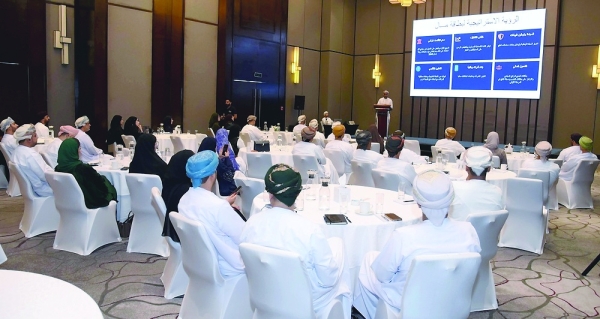
In April 2008, the first
‘Local Societies Forum’ was held in Muscat. The
three day event aimed to shed light on the
strategic role played by local societies in
serving society as well as highlighting
their pivotal role in enriching the voluntary
work culture.
Social Development:-
Education
Social Care
Health Services
Sports and Youth
Housing Services
Environment Services
|