Thursday, September 02

  Exact Any Word

Advance search

 
Home
About Omanet.om
Tribute to His Majesty
Awards
Religious affairs
Useful information
Omanisation Policy
History
Geography
Site map
Gallery
Oman Flag
National Anthem
Check mail
Guestbook
Free Newsletter


Oman’s Fishing Industry

By: Amirah Al-Alawi ‎

 Oman's Government development policy puts emphasis on the growth in ‎trade and industry sectors of non-oil division such as agriculture, fishing, ‎industry and mining. The challenge of the scheme is to branch out the ‎economy and moderate its dependence on oil exports. Its twin objective is to ‎prepare for a shortage supply of hydrocarbon reserves and uphold the ‎economic base.‎

For the purpose of this article, the focus is on the economic activity of fishery.‎ Oman's cost line stretches as far as 1700km-long, producing a traditional ‎livelihood in fishing, supporting the majority of the population before the ‎discovery of oil. The GCC provided the largest fish export market. Oman's ‎situated between the Gulf of Oman and the Arabian Sea, creating fishing as ‎second only to farming as an economic activity in pre-oil, presenting a range ‎of catches such as tune, shark, bluefish, sardines, abalone, lobster and ‎oysters.‎

As non-oil export revenue, fishing measures as one of the most promising ‎trades. In response providing employment opportunities to over 19,000 ‎registered fishermen in 1990, of which around 18,500 were employed in ‎traditional fisheries and 750 in industrial fisheries. Alarmed by the number of ‎people employed within the sector, the government stressed on modernizing, ‎expanding the fishing industry and developing its export prospects.‎

Several economic campaigns were launched aiming to develop the fishing ‎sector, naming 1988 and 1989 as years of Agriculture and 1991 and 1992 as ‎Year of Industry. The course of these campaigns is to encourage private-‎sector investment by allocating generous amounts of cash support for private ‎industry to be disbursed mainly though official development banks. Such as ‎Oman Bank for Agriculture and Fisheries that provides loans at good rates for ‎those within its repetitive activity.‎

The bank acts as a distributive institution, receiving an interest subsidy from ‎the government. In 1990 there were 1,308 loans, totalling RO 4.7 million. ‎Development programs also incorporate the government's policy of ‎indigenization, with a large component of funds.‎

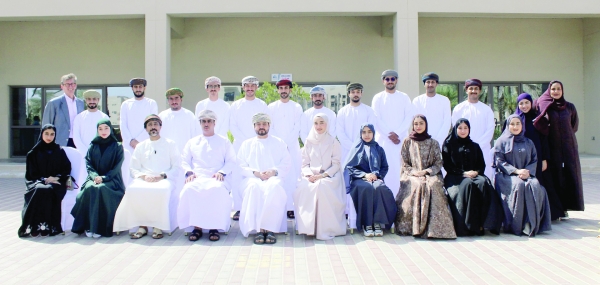
Youth Vessels Project were also launched with the purpose of modernising ‎the traditional fishing sector facilities. Its idea is to provide the youth with soft ‎loans to purchase the necessary fishing equipments and build boats. ‎Training centres have been operational since 2004 in Al Khabourah and ‎Salalah: training the students in navigation systems, quality control and vessel ‎repairs. This duel strategy develops fishing industry helping the existing ‎fishermen to stay in their profession as well as Omanisation manpower.‎

The government's actions are taken in the hope to increase private-sector ‎confidence in the fishing industry and develop the industry, accordingly United ‎States-Oman Commission joined in the funding of Oman Fisheries ‎Development and Management Project to strengthen the technical, ‎administrative, and management skills of the Directorate General of Fishing ‎Resources. ‎

This site is designed and maintained by Oman Electronic Network.
Copyright © 2002 Ministry of Information. All Rights Reserved.
Copyright of all photographs belongs to the Ministry of Information from whom permission must
be sought for use in any other format, i.e. whether this be in a printed or electronic form, or in a retrieval system