National Economy
Sub Section:
current year"s Budget
estimate
Oman enjoys a stable political, economic,
and social system, which is enhanced by the excellent relationships between the Sultanate
and neighboring countries. His Majesty, Sultan Qaboos, encourages market-orientated
policies and private sector development as the mechanism for prosperity and growth.
Commercial export of
oil began in 1967 and since Sultan
Qaboos' accession to the throne in 1970, many more oil fields have been found and
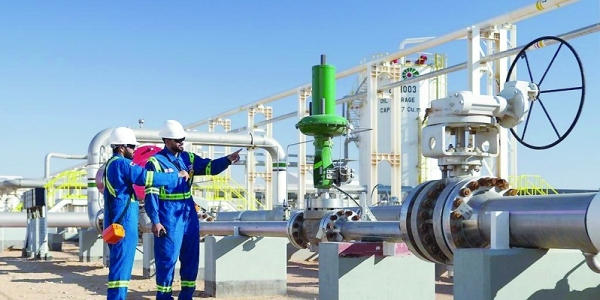
developed. In June 1999, Petroleum Development Oman (PDO) discovered a new
oil field in southern Oman after drilling and testing three wells which
demonstrated the commercial viability of the reservoir. This is the most
significant find in five years. Work is continuing on the RO503.876
million (US$1,300 million)oil refinery project in Sohar,which is due to
go into operation in 2006 with a 116,400 bpd refining capacity.In 2004
Oman Oil Refinery was supplied with about 78,200 bpd for refining,while
PDO began using steam injection technology in several wells to increase
their productivity.
Since the slump in oil prices in 1998/99,
Oman has made active plans to diversify its economy and is placing a greater emphasis on
other areas of industry, such as tourism and liquid natural gas.
Oman's Basic Statute of the
State expresses in Article 11, that, "The National Economy is based on justice
and the principles of a free economy."
The Vision Conference: Oman 2020, held in
June 1995, has developed the following aims with regard to securing Oman's future
prosperity and growth:
To have economic and financial stability
To reshape the role of the Government in
the economy and to broaden private sector participation
To diversify the economic base and
sources of national income
To globalise the Omani economy
To upgrade the skills of the Omani
workforce and develop human resources
By 2020, it is expected that the economy
will not be reliant on oil, but rather, will have diversified into non-oil sectors,
raising higher levels of savings and investments
The crude oil sector's share of GDP is
estimated to drop to 9% in 2020, compared with 41% in 1996
The gas sector is expected to contribute
around 10% to GDP, compared with less than 1% in 1996
The non-oil industrial sector's
contribution is expected to increase from 7.5% to 29%.
International economic recognition
The joint report by the Arab states' chambers of
commerce, industry and agriculture, published in
June 2006, praised Oman's economic achievements in
2005. A report by the Global Investment House in
September 2005 paid tribute to the Omani
government's economic policies, including its
efforts to create a positive economic environment,
promote economic diversification and raise the
Sultanate's credit rating.
A 2005 report by Transparency International
classed the Sultanate as the Arab state with the
lowest level of administrative corruption and
placed it 29th in the world out of a total of 159
states. No Arab state has previously attained such
a high rating. The International Research
Foundation and Canada's Fraser Institute awarded
the 2005 prize for economic freedom in the Arab
world to Oman on the basis of its economic freedom
index assessment criteria, which put the Sultanate
top out of the 16 Arab states taking part in the
2005 assessment. The Sultanate, together with
Qatar and Lebanon, shared a prize for monetary
policy awarded by the International Research
Foundation and the Fraser Institute in November
2005. The World Bank's 2004 report on the rule of
law and good governance put the Sultanate at the
top of its list of Arab states and in its November
report classified Oman as 17th out of 127 states
around the world.
Commerce:-
Overview
Finance & Banks
Oil & Gas
Trade & Industry
Mineral Resources
Agriculture & livestock
Water Resources
|